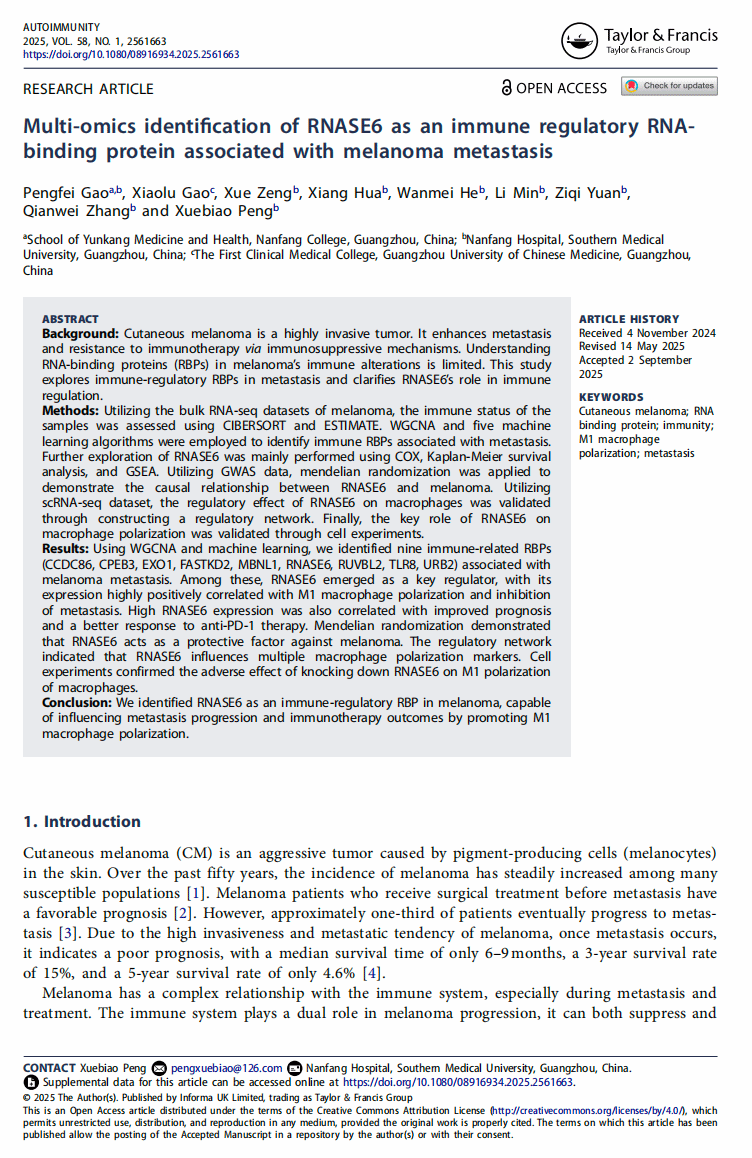
高鹏飞老师在刊物《Autoimmunity》(JCR分区:Q2,IF=3.1)发表“Multi-omics identification of RNASE6 as an immune regulatory RNA-binding protein associated with melanoma metastasis”论文。
ABSTRACT
Background: Cutaneous melanoma is a highly invasive tumor. It enhances metastasis and resistance to immunotherapy via immunosuppressive mechanisms. Understanding RNA-binding proteins (RBPs) in melanomas immune alterations is limited. This study explores immune-regulatory RBPs in metastasis and clarifies RNASEs role in immune regulation.
Methods: Utilizing the bulk RNA-seq datasets of melanoma, the immune status of the samples was assessed using CIBERSORT and ESTIMATE. WGCNA and five machine learning algorithms were employed to identify immune RBPs associated with metastasis.Further exploration of RNASE was mainly performed using COX, Kaplan-Meier survival analysis, and GSEA. Utilizing GWAS data, mendelian randomization was applied to demonstrate the causal relationship between RNASE and melanoma. Utilizing SCRNA-seq dataset, the regulatory effect of RNASE on macrophages was validated through constructing a regulatory network. Finally, the key role of RNASE on macrophage polarization was validated through cell experiments.
Results: Using WGCNA and machine learning, we identified nine immune-related RBPs (CCDC86, CPEB3, EX01, FASTKD2, MBNL1, RNASEG, RUVBLZ, TLR8, URB2) associated with melanoma metastasis. Among these, RNASE emerged as a key regulator, with its expression highly positively correlated with M1 macrophage polarization and inhibition of metastasis. High RNASE expression was also correlated with improved prognosis and a better response to anti-PD-1 therapy. Mendelian randomization demonstrated that RNASE6 acts as a protective factor against melanoma. The regulatory network indicated that RNASE influences multiple macrophage polarization markers. Cell experiments confirmed the adverse effect of knocking down RNASE6 on M1 polarization of macrophages.
Conclusion: We identified RNASE as an immune-regulatory RBP in melanoma, capable of influencing metastasis progression and immunotherapy outcomes by promoting M1 macrophage polarization.