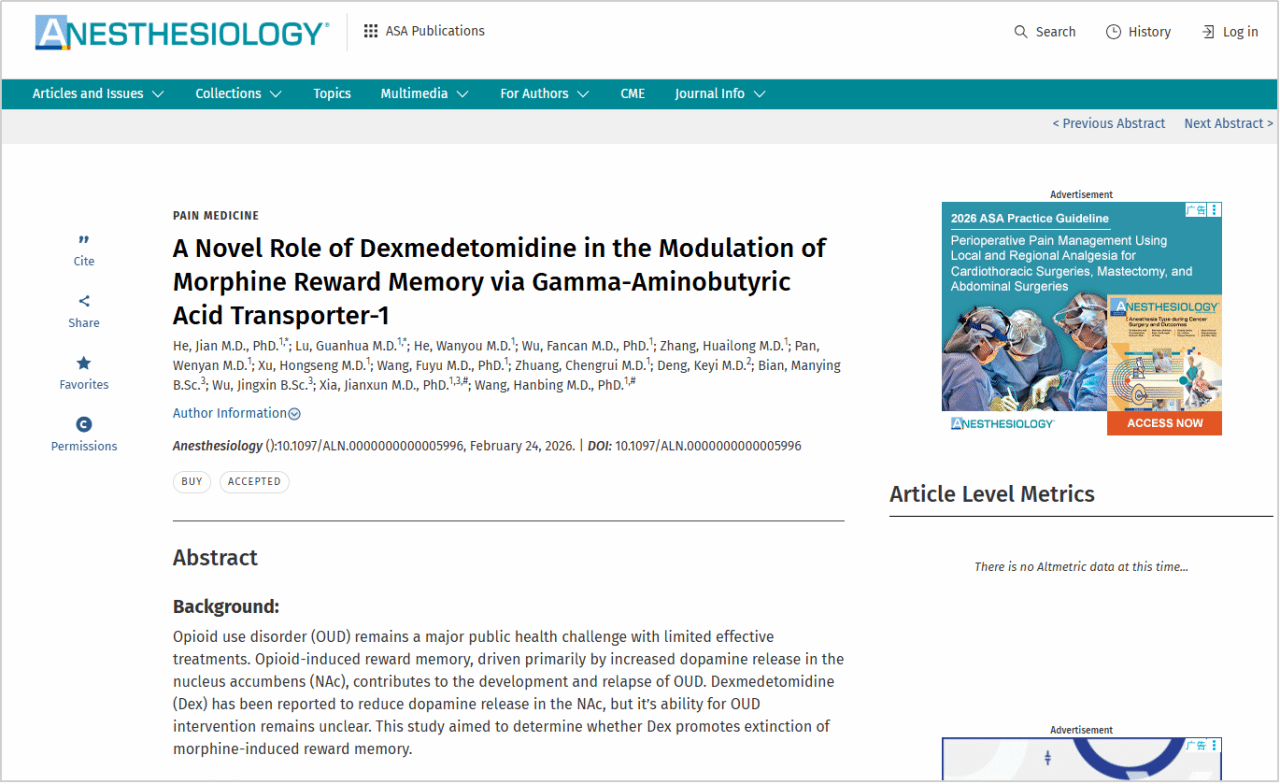
夏建勋教授在全球麻醉学领域顶级期刊《ANESTHESIOLOGY(麻醉学)》(JCR分区:Q1,IF=9.1)发表“A Novel Role of Dexmedetomidine in the Modulation of Morphine Reward Memory via Gamma-Aminobutyric Acid Transporter-1”论文。
Abstract
Background: Opioid use disorder (OUD) remains a major public health challenge with limited effective treatments. Opioid-induced reward memory, driven primarily by increased dopamine release in the nucleus accumbens (NAc), contributes to the development and relapse of OUD. Dexmedetomidine (Dex) has been reported to reduce dopamine release in the NAc, but it's ability for OUD intervention remains unclear. This study aimed to determine whether Dex promotes extinction of morphine-induced reward memory.
Methods: Adult male and female C57BL/6J mice were subjected to morphine-induced conditioned place preference (CPP) to evaluate reward memory. CPP scores were measured following systemic Dex administration or microinjection into the ventral tegmental area (VTA). Calcium imaging and whole-cell patch-clamp recordings were used to evaluate the excitability of dopaminergic and GABAergic neurons in the VTA and D1-type medium spiny neurons (D1-MSNs) in the NAc. Extracellular gamma-aminobutyric acid (GABA) and dopamine in the VTA and NAc were quantified using fiber photometry. Molecular docking and microscale thermophoresis were performed to validate the binding of Dex to Gamma-Aminobutyric Acid Transporter-1 (GAT1).
Results: Systemic and intra-VTA Dex administration facilitated the extinction of morphine-induced CPP and suppressed increased dopamine release with resultant hyperactivity of D1-MSNs in the NAc. In the VTA, Dex attenuated hyperexcitability of dopaminergic neurons by increasing extracellular GABA, without affecting GABAergic neuron activity or GABA synthesis. Molecular and functional assays demonstrated that Dex competitively inhibits GAT1, reducing GABA reuptake. Intra-VTA bicuculline-but not idazoxan-blocked Dex's pro-extinction effect, indicating GABA receptor but not α₂-dependent mechanism.
Conclusions: Dex facilitates the extinction of morphine-associated reward memory by competitively inhibiting GAT1, enhancing VTA GABAergic inhibition, and normalizing NAc D1-MSN activity. These findings reveal a novel GAT1 dependent, α₂-independent mechanism by which Dex modulates opioid reward circuitry, highlighting its potential as a therapeutic agent for OUD.